
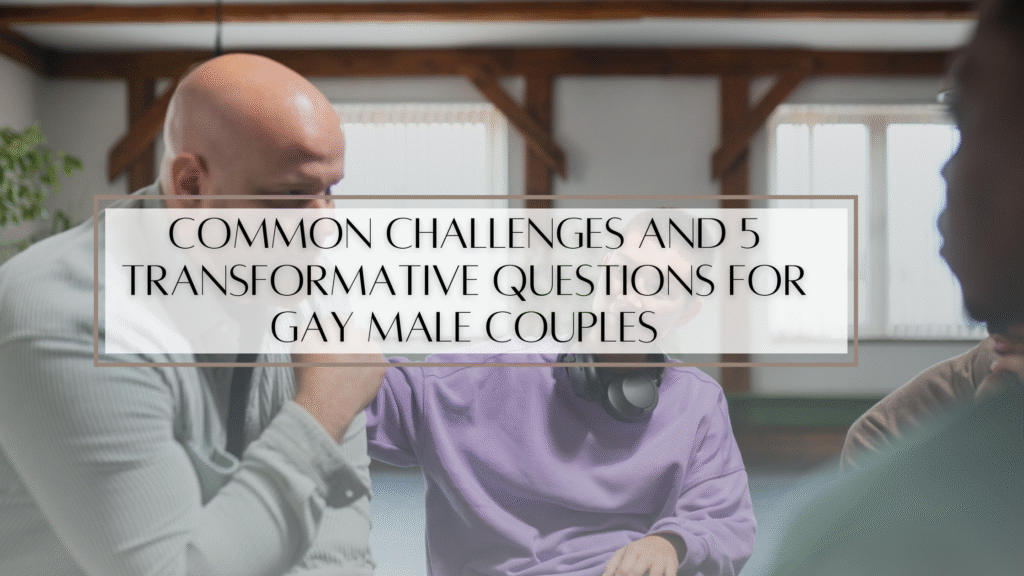
Gay male relationships are often filled with depth, love, humor, and resilience, yet they also carry unique pressures shaped by identity, culture, past trauma, and societal expectations. Many couples feel deeply committed but still struggle to communicate their needs, navigate conflict, or address emotional wounds that never had space to heal.
As a queer, trauma-informed therapist with nearly 20 years of clinical experience, Christina Wade, LCSW, supports gay men who want healthier communication, deeper connection, and a relationship built on truth rather than survival patterns. Her work blends CBT, DBT, ACT, attachment-based therapy, relational approaches, somatic techniques, and mindfulness — creating a grounded, non-judgmental space where partners can finally talk about the things they’ve avoided for years.
This guide explores common challenges gay male couples face and the five transformative questions Christina uses to help partners move from disconnect to clarity, from defensiveness to compassion, and from fear to choice.
Challenges Gay Male Couples Often Face
Identity Stress & Emotional Conditioning
Many gay men grow up masking emotions, hiding affection, or shrinking parts of themselves to feel safe. This conditioning doesn’t disappear when a relationship begins, it often surfaces as emotional withdrawal, conflict avoidance, people-pleasing, or difficulty expressing needs.
The Pressure to Be “The Strong One”
Some partners take on the emotional labor, always regulating, soothing, or stabilizing the relationship. Others feel pressure to appear confident, unaffected, or “in control,” even when overwhelmed. This imbalance slowly creates resentment and burnout.
Past Trauma & Relational Triggers
Childhood rejection, bullying, family conflict, spiritual trauma, or previous heartbreaks can shape how partners relate today. Old wounds get activated quickly, which is why arguments often feel more intense than the situation itself.
Sexual Identity & Intimacy Conflicts
Differences in libido, boundaries around monogamy, body image insecurities, or fears of vulnerability may complicate physical intimacy. When not addressed openly, this leads to distance and assumptions.
Navigating Community Expectations
From hookup culture pressures to comparison within social circles, gay men often absorb messages about masculinity, desirability, and status, all of which can influence relationship satisfaction and self-worth.
The Power of Transformative Questions in Therapy

Christina often tells her clients, “A relationship can shift the moment we ask a better question.”
Transformative questions interrupt automatic defenses and help couples access curiosity instead of blame.
Below are five core questions she uses to help gay male couples deepen communication and rebuild closeness.
1. “What story am I telling myself about my partner right now?”
Arguments often escalate from assumptions, not facts.
One partner might interpret silence as rejection, while the other uses silence to feel safe.
One might read frustration as criticism, while the other feels unheard.
This question helps partners slow down the emotional spiral and check accuracy.
Therapeutic Impact
- Reduces defensiveness
- Encourages emotional clarity
- Promotes accountability for internal narratives
- Creates space for more honest dialogue
Couples frequently discover that their fears, not their partner’s intentions, are driving conflict.
2. “What do I actually need right now that I haven’t said out loud?”
Many gay men learned early that expressing emotional needs was unsafe, “too much,” or not masculine.
So they communicate indirectly:
- Subtle hints
- Sarcasm
- Irritability
- Withdrawing
Naming needs directly is vulnerable, but transformative.
Therapeutic Impact
- Builds emotional intimacy
- Reduces miscommunication
- Helps each partner feel considered and cared for
- Encourages secure attachment patterns
Christina helps partners replace emotional guessing games with clear, compassionate communication.
3. “Is this reaction about my partner, or is it about something older?”
This question separates the present from the past.
If a partner shuts down emotionally, it may remind the other of feeling ignored growing up.
If someone raises their voice, it may echo a childhood memory of conflict.
Therapeutic Impact
- Helps partners see each other more accurately
- Breaks cycles rooted in past trauma
- Increases empathy and reduces blame
- Opens the door to healing rather than reactivity
Understanding triggers shifts the emotional tone of the relationship.
4. “How can we show love differently than what we learned growing up?”
Many gay men were never shown love that felt safe, affirming, or unconditional.
Some grew up with dismissal.
Some with chaos.
Some with silent households where vulnerability was unwelcome.
Christina helps couples define love intentionally — not reactively.
Therapeutic Impact
- Strengthens connection
- Reinforces shared values
- Builds a relationship that feels chosen, not inherited
- Encourages healthier emotional habits
Couples often create new rituals, communication styles, and soothing strategies that feel more aligned with who they are today.
5. “What future are we building, and are we both moving toward it?”
This is one of the most clarifying questions in therapy.
Some couples discover they have drifted into different directions without meaning to.
Others realise they share goals but haven’t communicated the roadmap.
Some feel committed but unsure how to repair trust or closeness.
Therapeutic Impact
- Reinforces shared purpose
- Clarifies goals and expectations
- Helps partners identify where effort is needed
- Encourages collaboration instead of competition
This question shifts the relationship from problem-focused to future-focused.
How Christina Wade Supports Gay Male Couples
Christina brings a warm, grounded, and deeply affirming approach. As a queer therapist, she understands the emotional terrain, identity nuances, relational dynamics, and cultural experiences specific to gay men.
Her therapeutic work includes:
- Building emotional safety
- Helping partners communicate without shutting down
- Addressing trauma, shame, and relational triggers
- Supporting clarity around monogamy, boundaries, and intimacy
- Healing past wounds that impact present connection
- Guiding conversations around identity, desire, and partnership
- Creating tools for conflict resolution and emotional regulation
Her clients consistently describe her style as honest, humorous, and deeply human, making hard conversations feel safer and more possible.
Why LGBTQ+ Clients Trust Christina
Rather than listing these, here is a more narrative, connected presentation:
Gay male clients often share that working with Christina finally feels like being understood without explanation. With nearly two decades of clinical experience and an LCSW license backed by advanced training in evidence-based and trauma-focused methods, she brings both expertise and lived understanding to the therapeutic space.
Her Master’s in Social Work from the University of Texas at Austin laid the foundation for her identity-affirming approach, while her ongoing advocacy for LGBTQ+ mental health reinforces the depth of her commitment.
Colleagues describe her as warm, humorous, and emotionally attuned — a therapist who creates immediate safety without ever diluting hard truths. Clients also value the accessibility of evening telehealth appointments and the practical support that comes with insurance acceptance, including Aetna and Carelon.
Together, these qualities make therapy with her not only effective, but grounded, compassionate, and deeply affirming.
Should You Consider Therapy as a Couple?
Therapy is not a sign of failure, it’s a sign of willingness.
If you find yourselves repeating the same conflicts, avoiding hard conversations, or feeling emotionally disconnected, therapy can help you:
- rebuild trust
- express needs without fearing judgment
- understand each other’s emotional wounds
- deepen intimacy
- break patterns that no longer serve your relationship
Whether your relationship feels strained or simply ready to grow, support is available.
Final Thought
A healthy relationship isn’t built from perfection, it’s built from awareness, courage, and consistency. Gay male couples therapy often carry deep histories of resilience, identity struggles, trauma, or conditional belonging. These stories shape how you love, protect, retreat, and reconnect. With the right guidance, you can turn these stories into sources of strength rather than barriers. Therapy with Christina isn’t about changing who you are; it’s about discovering who you can become together when the weight you’ve been carrying finally has space to soften.
Ready to Begin?
If you and your partner feel stuck, disconnected, or ready for deeper emotional clarity, Christina offers a free 15–20 minute consultation to help you explore whether therapy is a good fit.
📍 San Mateo & San Francisco, CA (Online only)
📞 (510) 686-3839


